
Shelf Life & Storage Conditions.
Understanding recommended rubber shelf life, polymer classifications and storage practices is important for maintaining the condition of industrial rubber products before use.
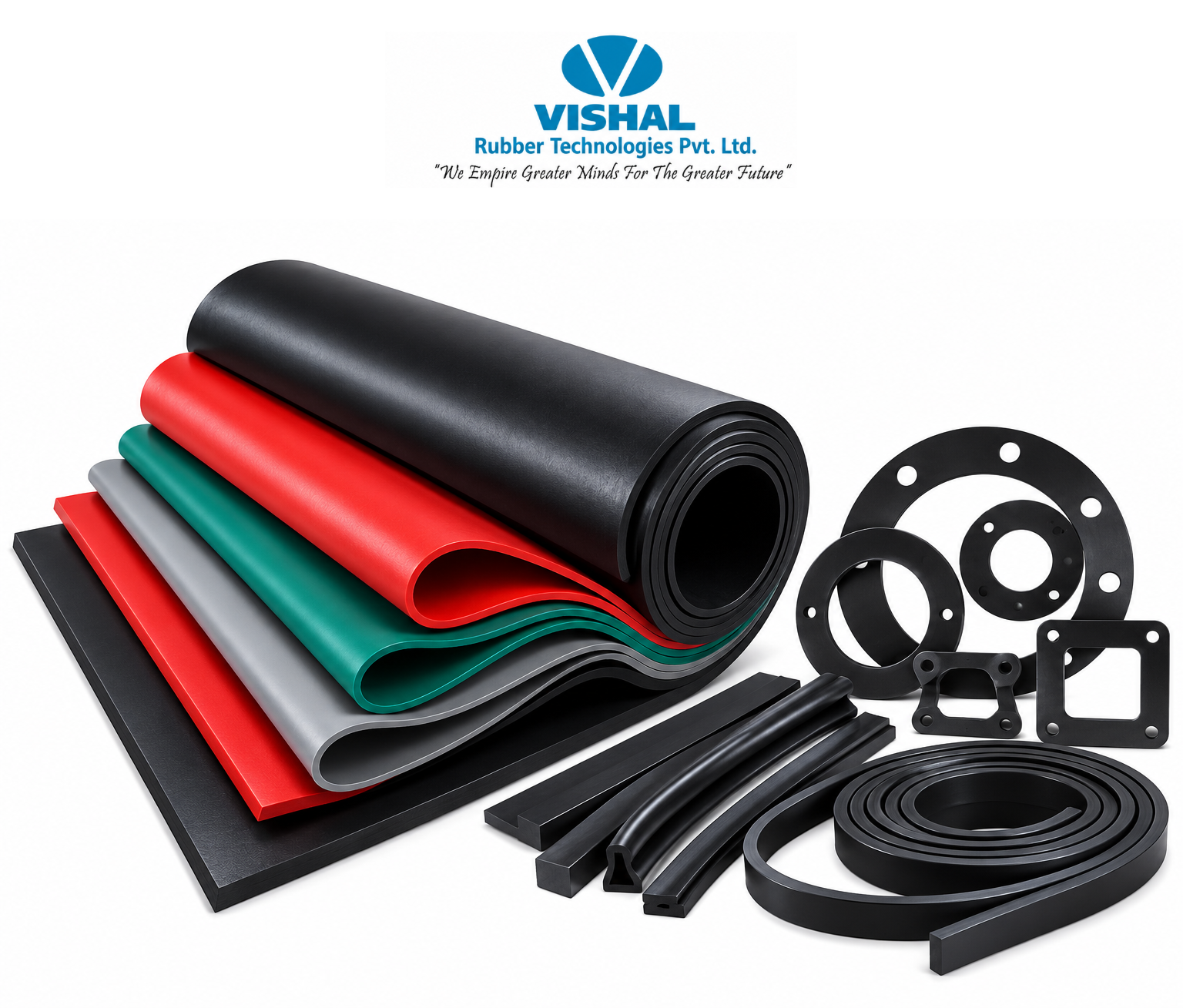
Protecting Product Condition Over Time.
Recommended storage periods vary according to the rubber polymer, compound formulation and actual storage environment.
The recommended shelf life of rubber products may vary depending on polymer type and compound formulation. Actual shelf life can differ substantially based on the conditions in which products are stored.
Vishal Rubber Technologies Pvt. Ltd. can discuss custom compound formulations for specific application requirements.
Rubber polymer type and compound formulation affect recommended shelf life.
Heat, sunlight, moisture and chemical exposure can influence stored product condition.
Shelf-life guidance should not be interpreted as a guarantee of service performance.
Recommended Shelf Life.
Reference classifications and recommended storage-life groups for common rubber materials.
These figures are recommendations for storage, not guaranteed usable life for every compound or application.
| Common / Trade Name | Rubber Polymer Type | ASTM D 1418 | ASTM D 2000 | MIL-R-3065 (MIL-STD-417) |
Recommended Shelf Life |
|---|---|---|---|---|---|
| Silicone | Silicone | Q | FE, GE | TA | 20 years |
| Viton® | Fluoroelastomer | FKM | HK | TB | 20 years* |
| Nitrile, Buna-N | Acrylonitrile-butadiene | NBR | BF, BG, BK, CH | SB | 5 to 10 years |
| Butyl | Isobutylene-isoprene | IIR | AA, BA | RS | 5 to 10 years* |
| Neoprene | Polychloroprene | CR | BC, BA | SC | 5 to 10 years* |
| EPDM, EP Rubber | Ethylene-propylene | EPDM | BA, CA | RS | 5 to 10 years* |
| SBR | Styrene-butadiene | SBR | AA, BA | RS | 3 to 5 years |
| Natural Rubber | Polyisoprene | NR | AA | RN | 3 to 5 years* |
| Synthetic Natural Rubber | Polyisoprene | IR | AA | RN | 3 to 5 years* |
| Neoprene (Commercial Grade) | — | — | BC | SC | 3 to 5 years* |
| Nitrile, Buna-N (Commercial Grade) | Acrylonitrile-butadiene | NBR | BF, BG | SB | 3 to 5 years* |
* The reference presents these shelf-life values as grouped ranges. Values marked with an asterisk follow the group shown in the original table. Individual compound formulations and storage conditions can affect actual shelf life. The dash indicates an unspecified classification in the source.
Store Rubber The Right Way.
Follow these six recommended conditions when storing industrial rubber products.
Keep Cool & Dry
Store in a cool, dry place with temperatures below 75°F (approximately 24°C).
Avoid Heat & Flames
Keep products away from direct heat sources and open flames.
Prevent Chemical Contact
Avoid contact with solvents, chemical fluids and other potentially damaging liquids.
Keep Out of Sunlight
Do not store rubber products in direct sunlight.
Protect from Moisture
Keep products wrapped or sealed to minimize moisture absorption.
Avoid Deformation
Store products in a relaxed condition, free from tension, compression and deformation.
Material Selection & Suitability.
Rubber products may be proprietary blends of different polymers formulated to satisfy stated physical properties and specifications. The named polymer does not necessarily represent the highest percentage of the compound blend.
The buyer or user is responsible for determining whether a product is suitable for the intended application. No guarantee is provided regarding service life in a particular application.
Product-use suggestions are provided as guidance. Results cannot be guaranteed because application and operating conditions are outside the seller's control.
Frequently Asked Questions.
Quick answers based on the shelf-life and storage recommendations above.
What determines the shelf life of a rubber product?
Polymer type, compound formulation and storage conditions all affect recommended shelf life.
What is the recommended storage temperature?
The referenced storage guidance recommends a cool, dry environment below 75°F, approximately 24°C.
Why should rubber be protected from sunlight?
The storage recommendations specifically advise avoiding direct sunlight to help preserve stored product condition.
Does recommended shelf life guarantee service life?
No. Recommended storage life is not a warranty or guarantee of performance in any particular application.
Can custom rubber compounds be discussed?
Yes. Contact Vishal Rubber Technologies to discuss compound requirements for your intended application.
Need Guidance on Rubber Materials?
Contact Vishal Rubber Technologies Pvt. Ltd. to discuss rubber material selection, compound requirements, storage considerations or custom industrial rubber products.